AI to help improve cataract surgery outcomes

cataract surgery

A revolutionary approach that uses AI to help improve cataract surgery outcomes could mean the majority of post-op patients no longer need glasses. A Knowledge Transfer Partnership (KTP) between visual computing experts at the University’s of Bradford’s School of Computer Science, Artificial Intelligence and Electronics (CSAIE) and ophthalmology company CustomLensAi has produced an AI-based tool […]

Read More… from AI to help improve cataract surgery outcomes

Machine learning for child vaccinations

child vaccinations

Machine learning for child vaccinations – Curtin University is collaborating with the Boorloo (Perth) Public Health Unit on a research project using a Future Health Research and Innovation Fund grant to develop a machine learning tool, in order to help better identify Western Australian children who are at risk of missing potentially life-saving vaccinations. The […]

Read More… from Machine learning for child vaccinations

Skin cancer diagnosis: Performance of AI explored

AI

Artificial intelligence (AI) is already being used to diagnose skin cancer, but it cannot (yet) keep pace with the complex decision-making of doctors in practice. An international research team led by Harald Kittler of MedUni Vienna has now explored a learning method in which greater accuracy in AI results can be achieved by incorporating human […]

Read More… from Skin cancer diagnosis: Performance of AI explored

Parkinson’s AI proves accuracy

Parkinson’s

The results of a multi-site clinical study analysing the performance of PDMonitor, a pioneering Parkinson’s Disease monitoring device from PD Neurotechnology that uses wearables and Artificial Intelligence (AI) to track and assess symptoms, have been published in Frontiers in Neurology, a leading peer-reviewed clinical neurology journal. The study compared PDMonitor’s automated assessments of Parkinson’s patients […]

Read More… from Parkinson’s AI proves accuracy

Dementia diagnosis could be fast-tracked with AI

dementia diagnosis

Dementia diagnosis could be fast-tracked using artificial intelligence: Different forms of dementia could be spotted sooner and more easily by analysing recordings of patients’ electrical brain activity using artificial intelligence (AI), according to new research. Scientists from the University of Surrey and the University of Newcastle have shown that it is possible to use electroencephalography […]

Read More… from Dementia diagnosis could be fast-tracked with AI

Ground-breaking clinical studies show the future of post-operative care and rapid discharge

clinical

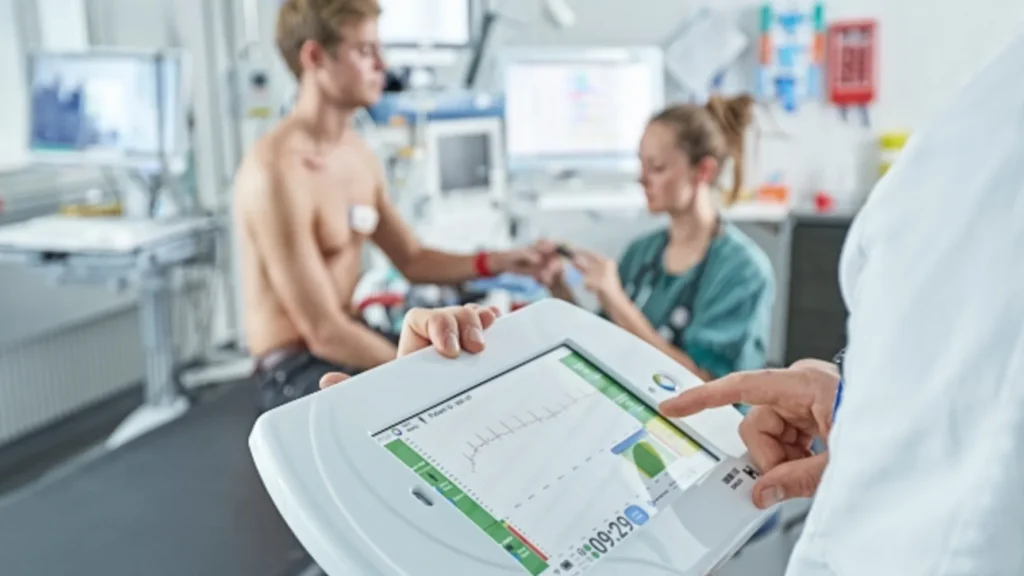
Three clinical studies have concluded that a new and ground-breaking monitoring system using artificial intelligence and wireless technology to monitor patients can identify clinical deterioration earlier than currently used “manual and simplistic” methods. Researchers from the WARD project (Wireless Assessment of Respiratory and circulatory Distress) at Rigshospitalet, Bispebjerg Hospital and the Technical University of Denmark, […]

Read More… from Ground-breaking clinical studies show the future of post-operative care and rapid discharge

WHO’s 6 guiding principles for AI in health

AI guiding principles

WHO issues first global report on AI in health and 6 guiding principles for its design and use. Growing use of AI for health presents governments, providers, and communities with opportunities and challenges. Artificial Intelligence (AI) holds great promise for improving the delivery of healthcare and medicine worldwide, but only if ethics and human rights are put at […]

Read More… from WHO’s 6 guiding principles for AI in health

AI for management of retinal diseases

retrain the eyes

Development of Artificial Intelligence for the management of retinal diseases – New Christian Doppler Laboratory opened at MedUni Vienna: The number of patients at risk of developing serious retinal diseases or even going blind in the future is growing much faster than the number of trained ophthalmologists. The time available for examination is decreasing in […]

Read More… from AI for management of retinal diseases

AI can predict survival of ovarian cancer patients

Researchers have created new machine learning software that can forecast the survival rates and response to treatments of patients with ovarian cancer. The artificial intelligence software, created by researchers at Imperial College London and the University of Melbourne, has been able to predict the prognosis of patients with ovarian cancer more accurately than current methods. […]

Read More… from AI can predict survival of ovarian cancer patients

AI to help find new heart drugs

World Heart Day

Researchers at Imperial are partnering with Bayer Pharmaceuticals to explore how artificial intelligence (AI) can accelerate the discovery of new drugs for heart conditions. An estimated seven million people are living with heart and circulatory disease in the UK alone, with cardiovascular diseases responsible for one in four deaths. Identifying and treating patients at an […]

Read More… from AI to help find new heart drugs