Cancer cells shrink or super-size to survive

cells

Cancer cells can shrink or super-size themselves to survive drug treatment or other challenges within their environment, researchers have discovered. Scientists at The Institute of Cancer Research, London, combined biochemical profiling technologies with mathematical analyses to reveal how genetic changes lead to differences in the size of cancer cells – and how these changes could […]

Read More… from Cancer cells shrink or super-size to survive
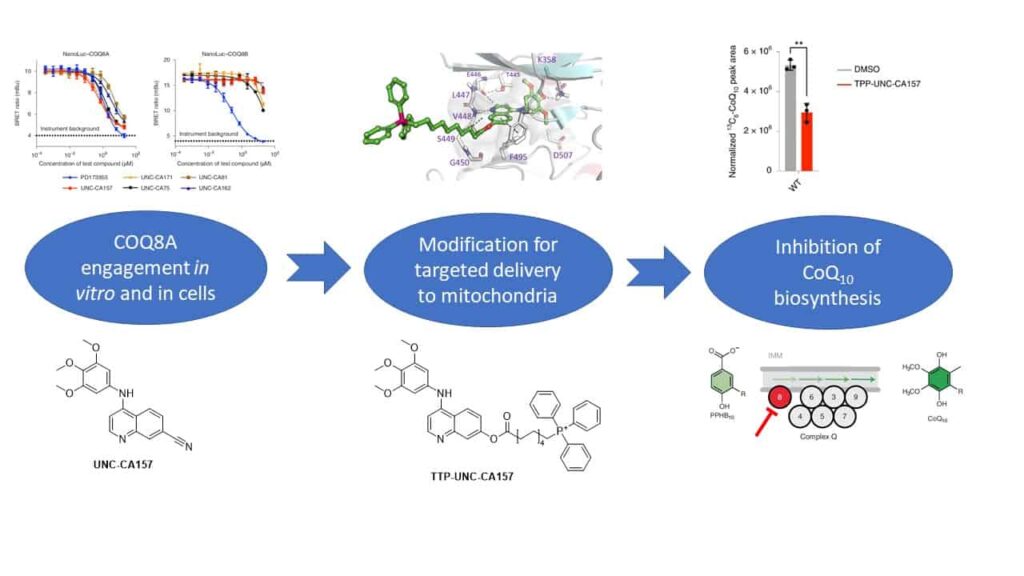
The first potent COQ8 inhibitor targets ubiquinone biosynthesis

The first potent COQ8 inhibitor targets ubiquinone biosynthesis: Inhibition of the COQ8 protein could be beneficial in the treatment of diseases such as cancer. COQ8 is needed for the biosynthesis of coenzyme Q, also known as ubiquinone. A new collaborative study from the University of Eastern Finland, Washington University in St. Louis, University of Wisconsin–Madison, University […]

Read More… from The first potent COQ8 inhibitor targets ubiquinone biosynthesis

Paradigm to enhance tumour targeting with biomimetic nanovectors

tumour

A new technique to improve the coating of nanoparticles used in cancer therapy may enhance tumour targeting, a new study carried out in collaboration between the University of Eastern Finland and Anhui Medical University in China concludes. Tumour targeting is a prerequisite for effective cancer therapy because it enhances the therapeutic outcome and decreases adverse […]

Read More… from Paradigm to enhance tumour targeting with biomimetic nanovectors

NHS Prostate Cancer Treatments Surge in England

prostate cancer surge

NHS Prostate Cancer Treatments Surge in England: The number of men having treatment for prostate cancer has jumped by more than a quarter in England in one year, new NHS figures show today. Almost 4,000 men received prostate cancer treatment in August (3,898) compared to just over 3,000 in the same month last year (3,057). […]

Read More… from NHS Prostate Cancer Treatments Surge in England

Innovating hyper-accurate cancer treatments

UQ paving the way for new hyper-accurate cancer treatments: An Australian-first research and manufacturing hub at The University of Queensland will lead the design and development of the next-generation of treatments for cancer patients. The newly created Australian Research Council Hub for Advanced Manufacture of Targeted Radiopharmaceuticals (AMTAR) will become a one-stop-shop for experts and […]

Read More… from Innovating hyper-accurate cancer treatments

Liver tissue regeneration

liver

If liver tissue has to be removed due to cancer or another liver disease, the organ usually regenerates quickly, soon becoming fully functional once again. Medical science has not yet completely understood the complex processes that enable tissue recovery following resection. Now, for the first time, a MedUni Vienna research team has discovered the vital […]

Read More… from Liver tissue regeneration

Study of antibodies for new cancer treatments

Scientists analyse structure of antibodies that could be key to more effective cancer treatments: Researchers at the University of Southampton have gained unprecedented new insight into the key properties of an antibody needed to fight off cancer. The interdisciplinary study, published in Science Immunology, revealed how changing the flexibility of the antibody could stimulate a stronger […]

Read More… from Study of antibodies for new cancer treatments

Junk DNA could lead to cancer

DNA could

Junk DNA could lead to cancer by stopping copying of DNA: Scientists reconstitute the entire process of DNA replication in a test tube Study shows how repetitive DNA sequences, or junk DNA, can stop DNA copying itself Understanding new route to DNA damage could point to new ways of treating the disease Scientists have found […]

Read More… from Junk DNA could lead to cancer

Deadly silica dust in the workplace

silica dust

As many as 10,000 Australians are predicted to develop lung cancer in their lifetime from being exposed to silica dust, new Curtin University modelling has found amid warnings more than half a million Australian workers are currently exposed to the harmful dust. Engineered stone – used mainly for kitchen benchtops – is a particularly potent […]

Read More… from Deadly silica dust in the workplace